
Automated Insulin Delivery Systems - A Practical Comparison Guide
If you or a loved one lives with type 1 diabetes (or certain cases of insulin requiring type 2 diabetes), you've probably heard the term "artificial pancreas" or "closed-loop system." These are more accurately called Automated Insulin Delivery (AID) systems, and there are currently six FDA cleared platforms on the U.S. market, spread across a handful of pump options. Each pairs a compatible continuous glucose monitor (CGM) with an insulin pump and an algorithm that automatically adjusts insulin delivery in real time.
As a Certified Diabetes Educator, I get asked constantly which system is “best.” The honest answer is that there isn't one. The right choice depends on your lifestyle, how hands on you want to be with your diabetes management, which CGM you prefer, and what your insurance covers. Below is a breakdown of each major system, how its algorithm works, and which settings you and your care team can actually adjust.
Quick Overview
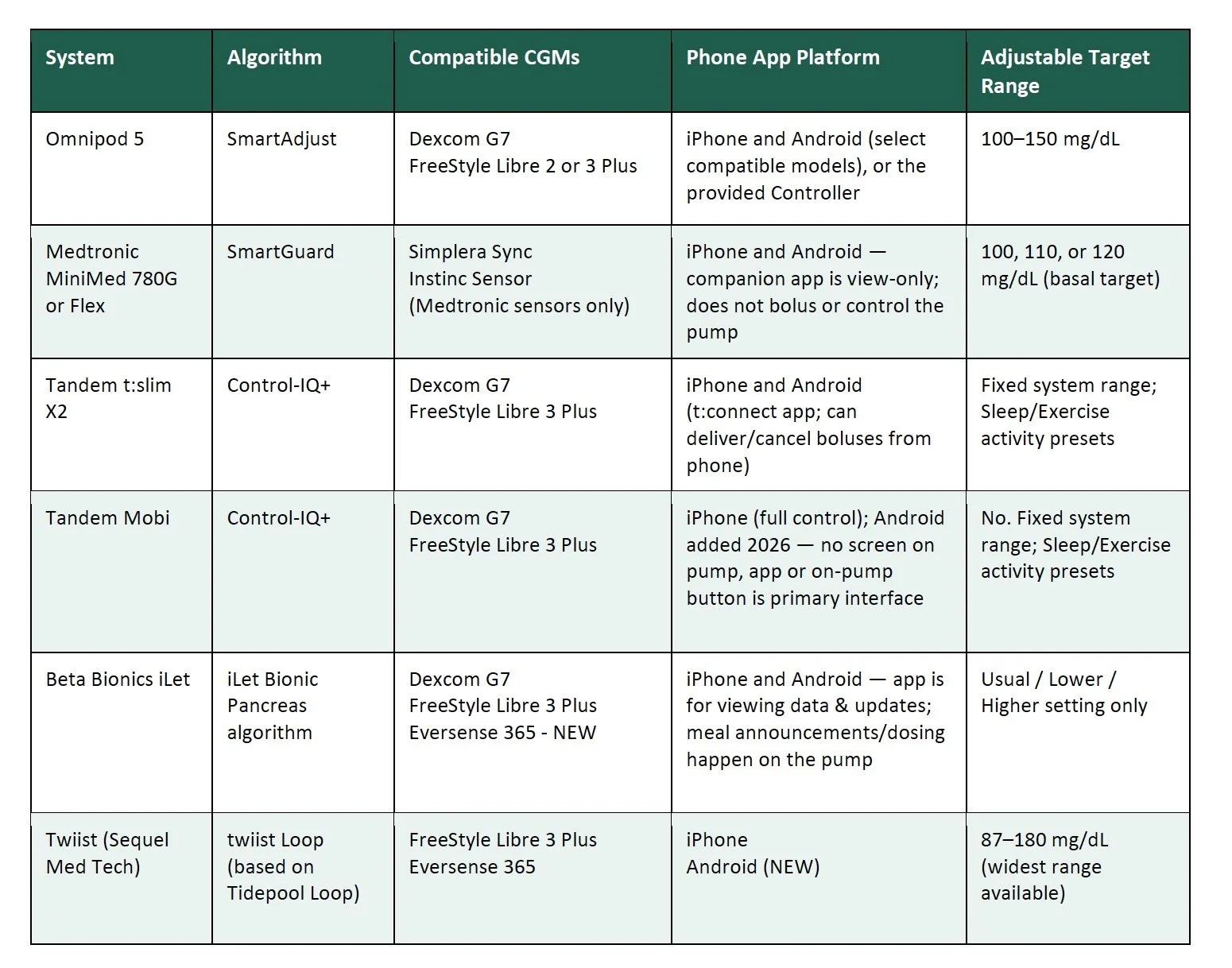
A theme worth calling out: several of these companion apps let you view data or receive alerts on both platforms, but not all of them let you actually dose insulin from your phone. Only Omnipod 5, Tandem (t:slim X2 and Mobi), Minimed Flex and Twiist currently support delivering a bolus directly from a smartphone or watch — the Minimed 780G and iLet still require you to interact with the pump itself for dosing decisions.
1. Omnipod 5 — SmartAdjust Technology
Omnipod 5 is the only tubeless AID system on this list (Beta Bionics Mint pump is coming soon in 2027). Insulin delivery happens through a small pod worn directly on the body, controlled by a smartphone app or a dedicated controller. Omnipod 6 coming in 2027.
CGM compatibility: Dexcom G7, FreeStyle Libre 2 and 3 Plus. CGM options vary depending on whether you're using the Insulet-provided Controller or your own phone.
Phone platform: The Omnipod 5 app runs on both iPhone and a defined list of compatible Android models (mainly newer Samsung and Google Pixel devices), giving full system control (dosing, pod changes, and settings) from either platform. Anyone without a compatible phone can still use the free Insulet Controller.
How it works: The SmartAdjust algorithm lives inside the pod itself, not the app, and recalculates a new basal rate every 5 minutes based on current and predicted glucose (60 minutes ahead). It does not deliver automatic correction boluses — corrections above the target still require the user to initiate a manual bolus using the built-in calculator.
What you can adjust:
• Target Glucose: 100–150 mg/dL, in 10 mg/dL increments, with up to 8 different time-based segments per day
• Activity Feature: Temporarily raises target to 150 mg/dL and reduces insulin delivery for 1–24 hours (useful around exercise, alcohol intake, sick days, etc)
• Standard insulin-to-carb ratio, correction factor, and max bolus settings used for manual boluses
• Basal rates themselves are not user-adjustable in automated mode — the adaptive algorithm sets these based on each pod's total daily insulin history
2. Medtronic MiniMed 780G — SmartGuard Technology
The 780G is a tubed pump paired with Medtronic's own CGMs (Simplera Sync or Instinct Sensor). It's known for its Meal Detection feature and the lowest adjustable basal target.
CGM compatibility: Simplera Sync or Instinct sensor only — this is a closed ecosystem, so Dexcom and Libre sensors are not compatible with the 780G.
Phone platform: The MiniMed Mobile app is available for both iPhone and Android, but it is viewing and data-upload app only. You also connect the Instinct sensor through the app (and Simplera Sync through the actual pump). You can watch your glucose trend and get alerts on your phone, but all bolusing, setting changes, and pump interactions still have to happen on the pump itself.
How it works: SmartGuard recalculates basal delivery every 5 minutes and can deliver automatic correction boluses as often as every 5 minutes if glucose is predicted to stay above 120 mg/dL and max basal has already been reached. If it detects a rapid glucose rise consistent with an unannounced or underestimated meal, it can deliver a stronger correction automatically.
What you can adjust:
• Basal (SmartGuard) Target: 100, 110, or 120 mg/dL. The setting combination associated with the highest published time in range is 100 mg/dL plus a 2-hour active insulin time.
• Active Insulin Time: 2–8 hours
• Insulin-to-carb ratios (used for meal boluses)
• Not adjustable: the auto-correction target, which is fixed at 120 mg/dL, and basal rates themselves, which the algorithm overrides
• Temporary Target (Exercise Mode): Raises the treatment target to 150 mg/dL and suspends auto-corrections while active
3. Tandem Control-IQ+ (t:slim X2 and Mobi)
Control-IQ+ is the algorithm; it runs on two different tubed pump bodies — the original t:slim X2 or the smaller Mobi, which is about half the size. Because the algorithm and adjustable settings are identical across both pumps, they're often grouped together, though the hardware and app differences matter for day to day use. It is also the only pump approved for pregnancy.
CGM compatibility:
• Dexcom G7 or FreeStyle Libre 3 Plus
Phone platform:
The t:slim X2 uses the t:connect mobile app, available on both iPhone and Android, which can deliver or cancel a bolus directly from the phone (the pump itself still has its own touchscreen as a backup).
The Mobi has no screen at all, it's designed to be run primarily through its own Tandem Mobi app.
How it works: Every 5 minutes, Control-IQ+ predicts glucose 30 minutes ahead using the CGM trend and the user's Personal Profile (basal rates, carb ratios, correction factor). Unlike Omnipod or twiist, it includes a true AutoBolus: if glucose is predicted to exceed 180 mg/dL, it will automatically deliver 60% of a calculated correction dose (using a 110 mg/dL target), up to once per hour.
What you can adjust:
• Personal Profile: basal rates, insulin-to-carb ratios, correction factor, active insulin time
• Sleep Activity: Narrows the treatment range to 112.5–120 mg/dL; no AutoBolus delivered during this window (designed to minimize overnight disruptions)
• Exercise Activity: Raises the treatment range to 140–160 mg/dL; AutoBolus can still fire, but only once per hour
• Extended Bolus: insulin can be spread out over up to 8 hours — useful for high-fat or high-protein meals
• Temp Rate: manual temporary basal adjustments for illness or unusual activity
• The overall treatment range itself (70–180 mg/dL backbone) is fixed by the algorithm; Sleep/Exercise presets shift where insulin delivery targets fall within it
4. Beta Bionics iLet Bionic Pancreas
The iLet takes a fundamentally different philosophy: no carb counting, no correction factors, and no basal rate programming at all. It's designed to reduce daily diabetes decision making to almost nothing beyond a meal announcement.
How it works: Three separate algorithms run basal delivery, corrections, and meal dosing. At setup, the clinician enters only the patient's body weight; from there, the system learns typical insulin needs and continually adapts. For meals, the user selects a meal type (breakfast/lunch/dinner) and a relative size (usual, more, or less) rather than a gram count — though users still need to be “carb aware.”
CGM compatibility: Dexcom G7, FreeStyle Libre 3 Plus and Everesense 365
Phone platform: The iLet App is available on both iPhone and Android. Like the 780G's app, though, it's mainly for viewing glucose data, sharing it with up to 10 family members or friends through the connected “Bionic Circle,” and installing software updates. Meal announcements and all dosing decisions happen on the pump device itself, not the phone.
What you can adjust:
• Glucose Target Setting: Usual, Lower, or Higher — a simplified three-option setting rather than a specific mg/dL number
• That's essentially it from a day-to-day user standpoint. There are no insulin to carb ratios, correction factors, or basal rates to program or troubleshoot — which is either the biggest advantage or the biggest drawback, depending on how much a patient values granular control versus simplicity
5. Twiist (Sequel Med Tech) — Twiist Loop, Powered by Tidepool
Twiist is the newest entrant and the first commercial pump to run the Tidepool Loop algorithm — the same open source derived algorithm the DIY looping community has used for years, now offered as an FDA cleared, supported commercial product. Its hardware (the Deka pump) is also the first to directly measure the volume and flow of every microdose delivered, which allows for very fine dosing (fractions of a unit) and fast occlusion detection.
CGM compatibility: FreeStyle Libre 3 Plus and the Eversense 365
Phone platform: iPhone and Android. Meal and correction boluses can be delivered from the phone app or a small button on the pump itself if you're away from both.
How it works: twiist Loop predicts glucose roughly 6 hours ahead and recalculates basal delivery every 5 minutes based on the user's insulin-to-carb ratio, insulin sensitivity factor, and target glucose. It does not deliver automatic correction boluses — insulin delivery is modulated entirely through basal adjustments plus user-initiated boluses.
What you can adjust:
• Target Glucose: 87–180 mg/dL — the widest adjustable range of any system on this list
• Insulin-to-carb ratio, insulin sensitivity factor, and basal rates (all standard Loop-style settings)
• Activity/Workout Presets: temporarily shift the target before or during exercise
• Retroactive carb entry: carbs can be logged or adjusted after a meal, which is fairly unique to this system. Can also select different absorption times for each meal
How to Think About Choosing Between Them
A few practical questions I walk clients through:
• Do you want the system making corrections for you, or do you want to stay in the driver's seat? The 780G and Control-IQ+ deliver automatic corrections; Omnipod 5 and twiist rely on you to bolus for highs; the iLet takes nearly all daily decisions off your plate entirely.
• Which CGM do you already like, or does your insurance push you toward? CGM compatibility varies meaningfully between systems, and the 780G is the only one tied exclusively to Medtronic's own sensors.
• Tubed or tubeless? Only Omnipod 5 is tubeless; everything else uses tubing.
• How much do you want to fine-tune settings? If you like granular control, Control-IQ+ or twiist give you the most levers. If you'd rather simplify, the iLet removes almost all of them.
As always, any settings changes (target glucose, active insulin time, carb ratios, or switching systems altogether) should be made in partnership with your endocrinologist or diabetes care team, not on your own. If you're weighing your options, that's exactly the kind of decision I help clients think through during diabetes counseling, since your carb-counting approach and meal patterns often shape which system will fit best.